

Technical Information
General
05/17/2026
Water purifier with inverter technology delivers more cold water with 70% less energy consumption
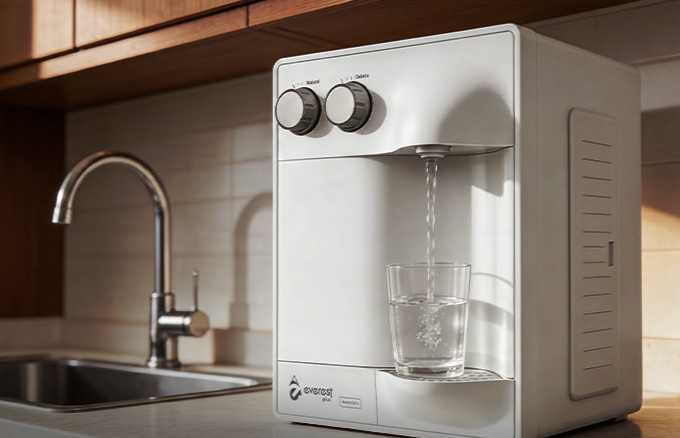
Everest Refrigeration is a benchmark in the Brazilian market for water purifiers and ice makers, and a partnership with Embraco has enabled the company to launch the first water purifier featuring inverter technology in the country, offering enhanced efficiency, quieter operation, and greater sustainability
Back to postsCelebrating its 60th anniversary this year, Everest Refrigeration is a benchmark in the Brazilian market for water purifiers and ice makers, built on a solid reputation of quality, reliability, and innovation.
A partnership spanning over 40 years with Embraco, a leading brand in refrigeration solutions, has now culminated in a unique offering for the Brazilian market: a water purifier that reduces energy consumption by 70% compared to Everest’s conventional Plus line. It also features a refrigeration system that allows the company to expand its production capacity without needing to invest in expanding its manufacturing plant.
Discover the details of this story!
Challenges
Looking toward the future of the water purifier market, Everest and Embraco identified an opportunity to simultaneously address four key challenges:
Deliver a more efficient and economical product to the end consumer.
Increase Everest’s production capacity within the physical space of the current manufacturing plant.
Adopt an even more sustainable natural refrigerant, aligning with international environmental agreements.
Maintain Everest’s market-leading edge and stay ahead of the competition.
Solution
To respond to these challenges, Embraco developed a complete solution: a customized sealed unit featuring an inverter (variable-speed) compressor and R600a natural refrigerant, engineered specifically for Everest's latest product, named Plus Inverter+, a water purifier for high-flow and high-demand noise-sensitive environments, such as companies, offices, and clinics.
What is a sealed unit, and why does it make all the difference?
A sealed unit is a "plug-and-play" solution that arrives at the production line fully ready for installation in the customer's application, integrating the entire refrigeration system: compressor, condenser, evaporator, filter drier, capillary tube, and the natural refrigerant charge. The evaporator, an essential component of purifier technology, is manufactured by Everest and assembled by Embraco into the final solution. It is hermetically sealed, which serves as a key differentiator for Everest.
Utilizing a refrigeration system that arrives ready for installation in the equipment allows Everest to increase its production capacity without the need to source individual components from multiple suppliers or invest in new assembly lines, while also reducing the number of Stock Keeping Units (SKUs) on the factory floor.
The adoption of a sealed unit also eliminates the need to handle refrigerant fluids during the purifier's manufacturing process. This allowed Everest to easily adopt a more environmentally sustainable natural refrigerant, such as R600a. Otherwise, implementing R600a without the sealed unit would have required significant investments to adapt the production infrastructure.
What is the secret to achieving 70% energy savings?
At the core of the sealed unit lies the Embraco FMS, an inverter compressor featuring variable-speed technology. This technology enables the compressor to dynamically adjust its operation according to the cooling demand of the equipment, scaling from its lowest to highest RPMs and eliminating the constant on-off cycling typical of conventional compressors. The result is a significantly more energy-efficient purifier, with the added benefits of quieter operation and an extended product lifespan.
The FMS, in particular, is a solution engineered to democratize access to variable-speed technology. It is one-third smaller than its predecessor, the EMI, yet delivers the same cooling capacity with greater energy savings.
Additionally, the new compressor features automatic dual-voltage capability, eliminating the need for consumers to choose between 110V and 220V. This simplifies installation across any environment and enhances the equipment's robustness by making it more resilient to voltage fluctuations.
Results
The new purifier enters the market with concrete and measurable results across multiple fronts:
COMPARATIVE ANALYSIS: STANDARD EVEREST PLUS VS. EVEREST PLUS INVERTER+
The new purifier hits the market with concrete and measurable results across several fronts:
Item | Conventional Plus | Plus Inverter+ | Advantage |
|---|---|---|---|
Energy Consumption | 6.450 kWh/month | 1.910 kWh/month | 70% lower consumption. Based on the energy consumption from the NBR 16236 test method |
Weight | 13 kg | 9.8 kg | 25% lighter. |
Noise Level | 61 dBA | 50 dBA | 15% quieter. |
Refrigerant | R134a | R600a (natural) | Global warming potential (GWP) reduced from 1,430 to 3. |
Cold Water | 1,896 L/h | 2,000 L/h | 5.5% capacity increase |
Additional results:
Pioneering Position: Everest becomes the first water purifier manufacturer to implement inverter technology in its products in Brazil.
Embraco’s accumulated experience with other customers who have adopted inverter technology across different applications also points to another significant outcome: an up to 80% reduction in field failures. This translates into a product that promises greater durability.
“The Everest Plus Inverter+, born from our partnership with Embraco, represents a highly significant technological advancement in our portfolio by introducing inverter technology to water purification, securing our position as pioneers in this segment. The product addresses three strategic market trends: growing concern over energy consumption, the demand for continuous-service solutions in corporate and professional environments, and the search for quieter, more durable, and sustainable equipment," states Carlos Alexandre Guimarães, Commercial Director at Everest.”
Looking to achieve similar benefits for your products?